

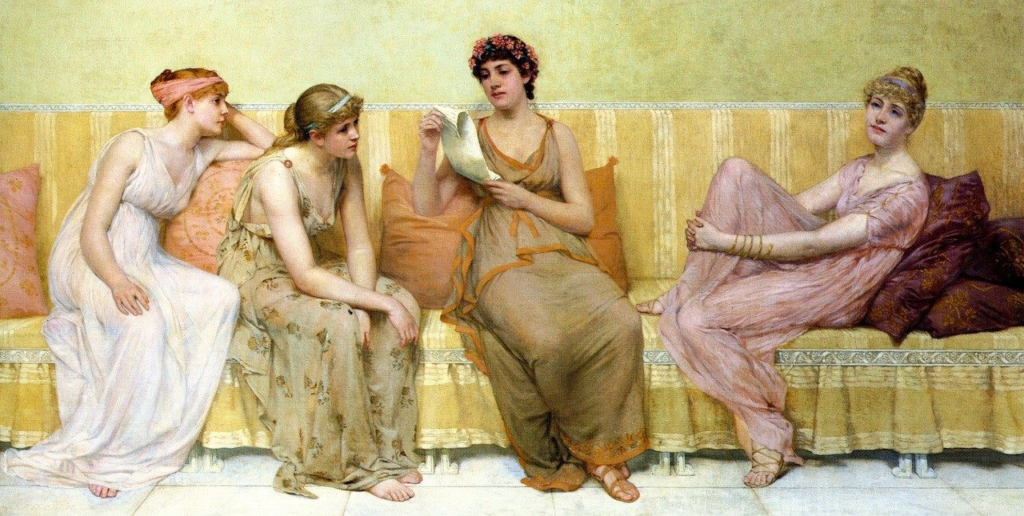
Reading the Story of Oenone
Description
Highly technical in detail the painting has been carefully crafted in hues of green, yellow, red and white. The painting maintains some visual tension by employing a golden mean “balance” with three of the women seated together moving from the reader positioned nearly center and leaning toward a pair of listeners seated to the viewers left. A single woman is reclining to the viewer right with hands clasped around her right leg and leaning back, upon two dark detailed pillows, in a daze of contemplation. The two outer women are dressed in simple classic Greek robes. The one on the left is primarily in tones of white and blue with a mauve cloth band wrapped around her deep colored red hair. She leans forward toward the central reader resting an arm upon a lightly detailed peach pillow, which matches one showing behind her back and cut off by the left edge of the painting. The woman on the right is painted in subtle tones of red, mauve and blue which reflect onto her skin and slightly reddish blond hair. The two central women have more ornate costumes with the one on the left clad in forest green gauze highlighted with a periodic floral motif. The central “reader’s” dark forest green robe is the most elaborate with deep orange gold lace and ribbons that echo the identical color of the pair of pillows behind her back acting as a dark contrast to the plain field of green gauze on the balance of two piece gown.
The couch is richly decorated with golden yellow fabric which is highlighted with groups of four vertical golden stripes evenly spaced across the back of the couch. A pair of corresponding gold stripes runs horizontally across the ruffled front of the couch which is supported by matching pairs of opposing “L” bracket feet. The whole couch is set upon large squares of a light “stone” looking floor which picks up the mix of blue, yellow, white and skin tone blush.
The painting references the story in Greek mythology, Oenone (ɪˈnoʊni, in Ancient Greek “wine woman”) was the first wife of Paris of Troy, whom he abandoned for the Queen Helen of Sparta thus starting the Trojan War. This “bench or sofa painting” of four young ladies reading the tragic love story was an excellent venue for the artist to demonstrate detailed knowledge of classical garb. A number of artists such as Alma Tadema, Albert Moore and others used the Bench style to paint elaborate or decorative settings as a technique. Millet was renowned as an expert in Greek and Roman clothing design. He created all the costumes in 1881 for a Greek play at Harvard and he was responsible for creating Greek costumes for a renowned actress of the day, Mary Anderson (de Navarro).
Francis Davis Millet, preferred the English rather than French pronunciation of his last name, and generally signed his work FD Millet. He was also known as Frank Millet often signing letters as Frank. Millet sold the painting to the then brand new Detroit Art Institute in 1883 as their first acquisition because of a vote by the public following their opening exhibition.
Exhibitions
1883 Inaugural exhibition of the Detroit Institute of Art
Provenance
1883 Purchase by Detroit Institute of Art, Inaugural Exhibition, Painting was purchased by DIA following a vote of attendees as the favorite piece of art in the exhibition.