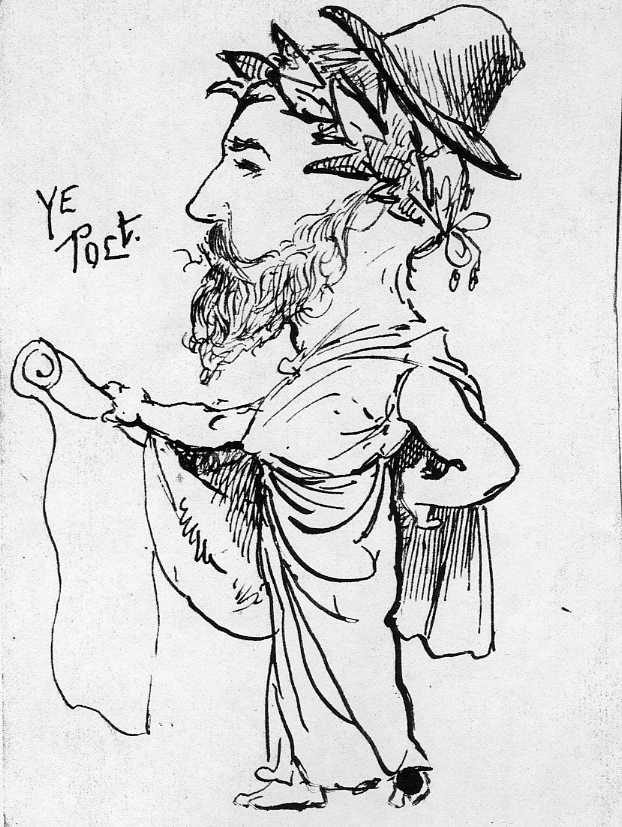
Millet the World’s Expert on Greek & Roman Costume
Description
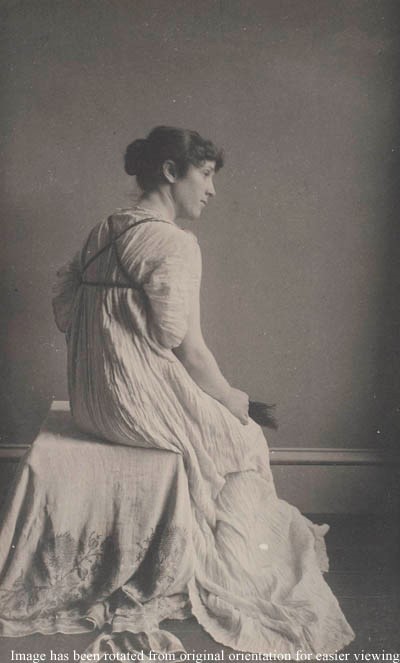 This photo is of Millet’s wife Lily in one of his Greek dresses, showing the Strophion strap around her top that closed and held the dress in place.
Exhibitions
While Millet’s costume lectures in both the US and Europe were not technically exhibitions, he often brought examples and models of the Greek and Roman costumes he had researched. 1881 Transcription of: The Critic, April 9,1881, page 95 Mr. Millet on Roman Costumes It is to be regretted that the two classes of New Yorkers who would probably be most benefitted by the suggestiveness of Mr. F. D. Millet’s interesting lecture on Roman costumes (viz., the ladies and the stage managers), were apparently not invited to the hall of the new Union League building along with his fellow artists on Wednesday evening of last week. It would be well if our countrywomen, before the new gospel of ugliness reaches them from mediaeval London, could have an opportunity to see out of what simple forms—merely a long sheet and a slitted meal-sack— the dignity and beauty of Roman dress were mainly composed. Many of these costumes, we understand, were made in New York from Mr. Millet’s designs and measurements, and we do not see anything impracticable in the adoption into American dress of those which were worn by the Roman women. They would certainly be adapted to our summer life, and, with due regard to the fabric, to the more formal needs of “the season;” and they would afford sufficient range in quality of fabric if not in color. To be sure, not every woman nor every type of woman would be able to carry off the suggestion of the antique which would be involved; but within the ordinary limits of judgment the vogue could be so readily established by a few of the best women of New York, that, even though it should give way before other fashions, it would make a precedent of good taste to which in future the wearied women of America would recur again and again with relief and profit to themselves and with pleasure and advantage to everybody—except the belated dressmaker. As for the managers—they might have taken from Mr. Millet’s lecture many a much-needed hint toward the reconstruction of the Roman period and have learned much more than to spare us here after the not infrequent conjunction of sandals with the toga, which Mr. Millet characterizes as no less an absurdity than top boots with evening dress. This presumption upon public ignorance of archaeology, while money is vulgarly lavished on the over loading of a play, is by no means uncommon. Sometimes it takes on the aspect of a public insult, as when in a recent play at Booth’s a scene in Rome was exhibited with a background purely Gothic We can hardly expect on the front of the theatres any archaeological mission-work—except perhaps from the Madison Square—but an audience is entitled at least to the consideration implied in a good look at the lumber-room. It may not be too much to expect that, some day, artists who, like Mr. Millet, have made special study of a certain historical period may be consulted, if not retained, by our theatres as experts; or is the dependence unalterably placed upon the traditions of the Bowery customer? – The Critic 1881 Henry Norman, wrote a review that was so long it was published as a book. The book focused on an 1881 Harvard University production of the play Oedipus Tyrannus, or Oedipus the King, which is an Athenian tragedy by Sophocles. . While he was critical of the Harvard actors production of the play, he was very complementary of the costumes which the University paid Millet to produce. In fact, Mr. Norman felt that it was Millet’s costumes and his good nature with the students in the production that made it the success it was. Norman encouraged people to attend if only to enjoy seeing Millet’s costumes. Harvard University records show that Millet was paid over $800 for the costumes for Oedipus Tyrannus, which today would be the equivalent of $23,000. Account Title Page of the Harvard Greek play. By Henry Norman (1) Account ,Costume PHOTO, of the Harvard Greek play1882 (1) Account, description of FDM costumes of Harvard Play pg. 2, 1882 1882 Millet was sought out by all kinds of audiences, the following clipping reviews one of his many costume lectures given in 1882. CostumeLecturesArtStudentJune1882 (1) Interested readers may want to look at a few of the costumes Millet created for Mary Anderson, also shown as an example of his work, on the Gallery page of the website.
Literature
Publications: